 |
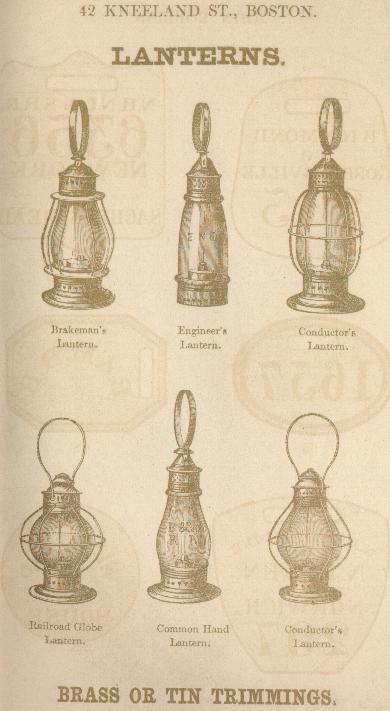
| Sorry about the baggage tag "ghosting" but this catalog is well over 150 years old. |
Introduction and the New England Glass Company
Scott Czaja
Introduction
Fixed globe style lanterns are one of the true mysteries in the Railroadiana
collecting hobby. With a little luck, this page may demystify some of the
common misconceptions and make some characteristics of these very early
lighting pieces more familiar to collectors. These lanterns are often misunderstood
and not appreciated for their real beauty. By definition a "Fixed GLobe"
lantern is a lantern that has its respective globe sealed within it's frame.
Typically the globes are plastered to the frame top and bottom assemblies.
There are many examples where plaster was not used and the lantern is made
with the globe sealed into the lantern without plaster. This type of lantern
will have vertical wire protection.
There are often errors made when attempting to date and identify manufacturers of these lanterns. It is very difficult to date some of these early pieces, so a good place to start is with some factual documentation on how early these lanterns really are. An 1859 John Robbins Catalog for Baggage Checks has a page of lanterns sold by Robbins to his customers. There is no implied original manufacturer of these lanterns. Robbins bought them wholesale and resold them. By the late 1860s Robbins didn't offer lanterns in his catalog. The image below states that any model can be made of brass or tin. It is generally assumed that brass models are typically "Conductor" models and that tin models are typically "Engine" or "Brakeman" models. The types of lanterns available:
|
|
| Sorry about the baggage tag "ghosting" but this catalog is well over 150 years old. |
More details of the terms used follows.
Definition of terms
Globe refers to the glass portion of the lantern. Globe
types:
Onion - squat and bulbous (generally free
blown)
Free blown - not molded, glass blower is
given top and bottom frame dimensions and adjusts ends during glass blowing
process.
Molded or Cast - a globe that is made
in a mold and not free blown
Ring(s) - sometimes there are raised rings
of applied glass to the top and sometimes to the bottom of the globe too.
Plaster - used to attach globe to frame
Frame refers to the non-glass portion of the lantern, frames
generally consist of::
Japanning or Creosote - originally used as
a manufacturer's coating to help preserve the frame.
Bail - used as a handle
Top assembly - has the
exhaust vents and bail connects to globe
Base assembly - connects
globe to frame bottom
Font or Fount - fuel pot
Burner - holds wick and sometimes connects
to collar
Collar - sometimes holds burner to fount
(when glass fount is used) usually plastered to fount
Springs - mechanism to remove fount/base
so that fuel can be added
History of the New England Glass Company
New England Glass Company - The easiest company
to start with is the New England Glass Company. They operated at a few
locations,
however, they are best known for their Cambridge, Massachusetts location.
They were making various glass products as early as 1818. They operated
until 1888. They are better known in the glass collecting field as "Cambridge
Glass." The exact date that New England Glass began making
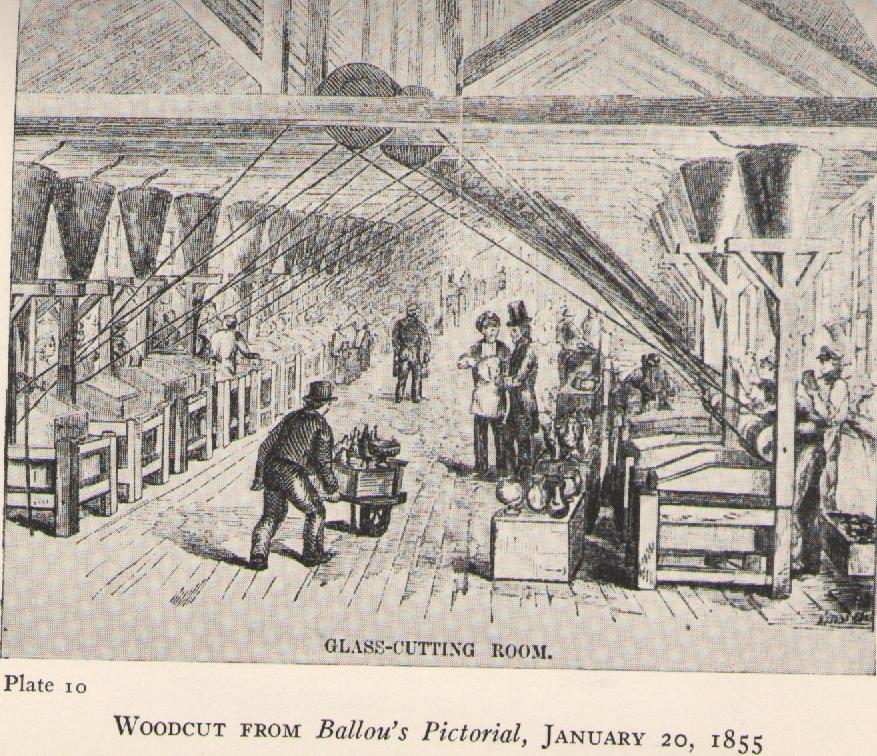
railroad lanterns is not known. The image below is very interesting because
it shows "The Cutting Room." This is where skilled German
craftsmen would do ornate artistic patterns, cutting into decorative glass
objects. It would be nice to think that railroad "cut" fixed globes were
the result of a skilled German craftsman, however, the simple designs required
did not necessitate that level of skill. It is more likely that apprentices
were assigned to do the cutting of railroad globes. The wood block of the
cutting room clearly shows that the copper driven wheels were overhead
belt driven (in earliest times by water, later by steam). More detail on
the making of railroad fixed globe lanterns follows.
 |
|
|
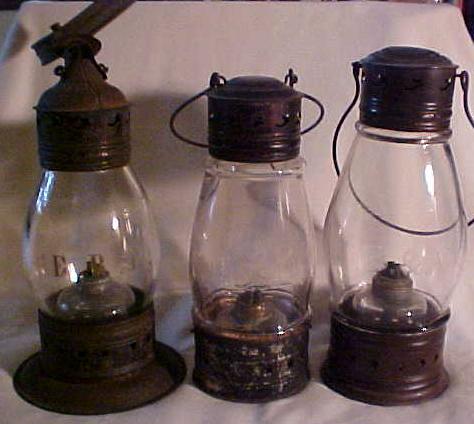
| 3 New England Glass Company Lanterns | ||
 |
||
| Eastern Railroad with "nipple" top, triangular cut letters with no rings on the globe, standard "Brakeman" base and a pewter fount | Atlantic & Saint Lawrence Railroad "engine" style frame with a cast globe and pewter collar. Note the bail is through the top. | Boston & Albany cut globe with applied rings and a "hybrid" 1868 base. Note the bail is under the top. |
N. E. Glass basic fixed globe lantern types
New England Glass Co. made various fixed globe lantern styles. They
can be identified by many characteristics:
Top Assembly Vents and Bail Retainers
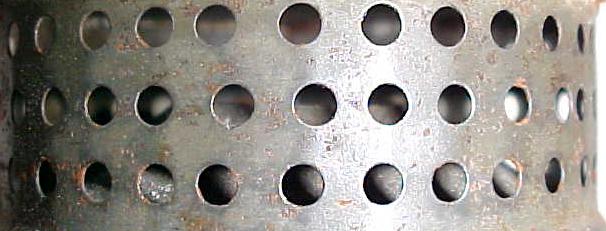
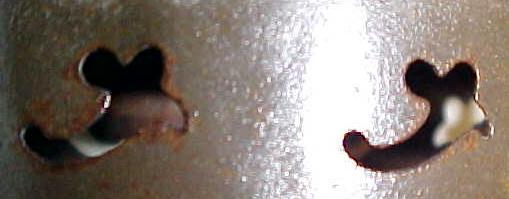
| New England Glass Company Top Vent Hole details | ||||
|
||||
| The top image is the standard "dagger with
cross-hatch".vent hole assembly
The bottom image is the "three parallel rows of round
holes". The bottom image is from a removable globe NEGlass lantern, however,
this style does exist for fixed globes.
|
||||
Globes
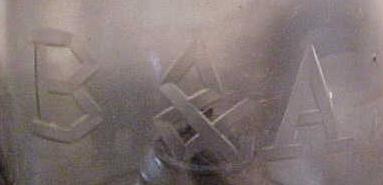
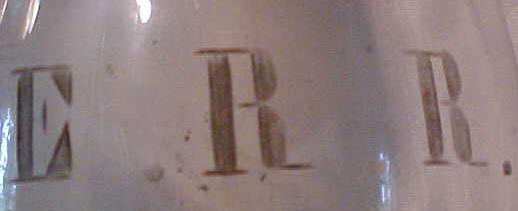
| 3 New England Glass Company Cut Globes | ||
|
||
| Eastern Railroad "triangular cut" globe. Note the narrow horizontal lines | Boston & Albany wide cut "block" style lettering. It's interesting that there is no "RR" marking.. | |
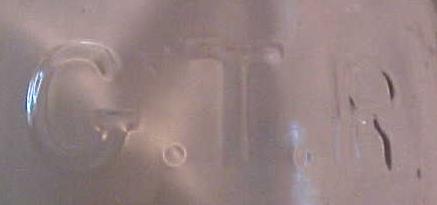
| Grand Trunk Railway cast globe | ||
 |
||
| Grand Trunk Railway (post Atlantic & St. Lawrence) cast globe. This image does not show that these letters are in a square panel. | ||
Base Assembly
| 3 New England Glass Company bases |
|
||
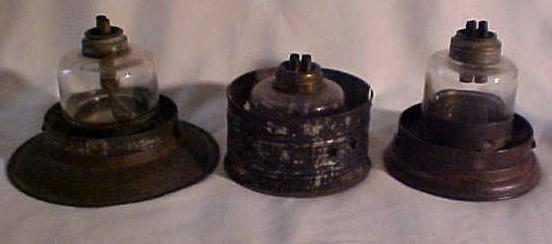
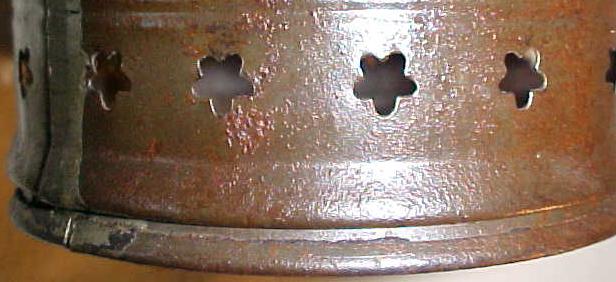
From left to right: (1) A standard 1854 patent bell, (2) "engine" base and (3) "hybrid" base.
Detail of "rounded five point star" intake holes on base assembly. This type of intake hole is unique to NEGlass. Also note the bottom ridge that holds the spring loaded bell assembly. |
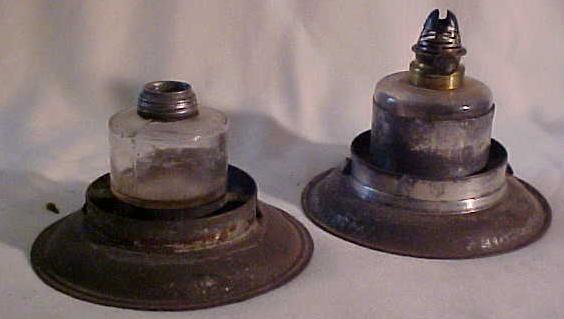
The American Glass (left) is very early (note the pewter collar). The 1868 base (note the tin fount retainer) has the spring extensions clearly visible. |
||
| Standard 1854 Patent bottom |
|
||
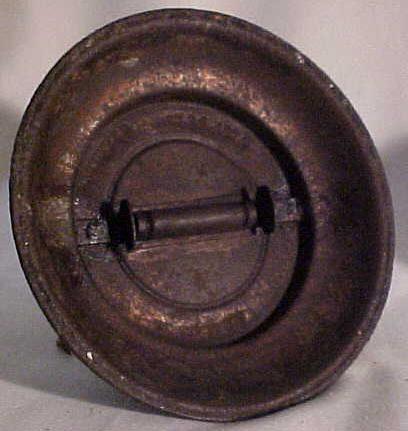
This is a standard NEGlass fixed globe bell assembly. Note the heavy amount of original creosote still present. That's not rust. |
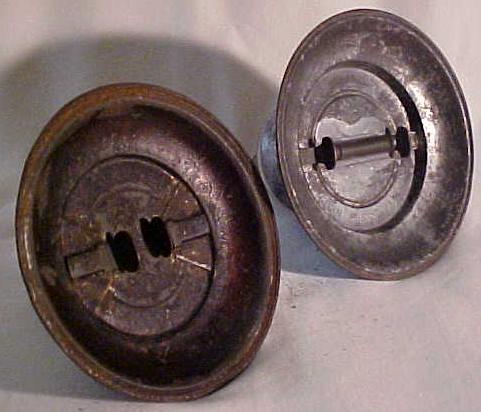
The bell on the left is actually an American Glass Company fixed globe bell. This base easily interchanges with any NEGlass frame. The bell on the right is an 1868 NEGlass bell assembly. |
||
What to watch for if you are buying a NEGlass fixed globe lantern
FUTURE - PART II - The other types of fixed globes
II. Star-dot-star
A. globe types
1. applied barrels
2. without applied barrels
3. how were they made
B. Cutting styles
1. Old English
2. thin block wheel cut
3. thick block wheel cut
C. Who made them?
1. VCRR - small pieplate cookie
cutter top (NEGlass?)
2. "Jar" style VCRR - (NEGlass?)
III. Kelly style - wire protection
A. I only have one VCRR with the top deflector
B. I had a NYC (pre hudson river) that had
no deflector
C. I have a weird off-set vertical model
(no rr mark)
IV. Engine lamps of the B&A
A. C.T. Ham
B. Steam Gauge
C. Colors
V. Etc.
NY&NE Blue Engine
OC&FR Cast
Blakes Patent